Dried Coffee & Tea on Carpet? Lift Stains Without Wick-Back
See how weighted white towel extraction stops deep brown rings from rising back as fibres dry.
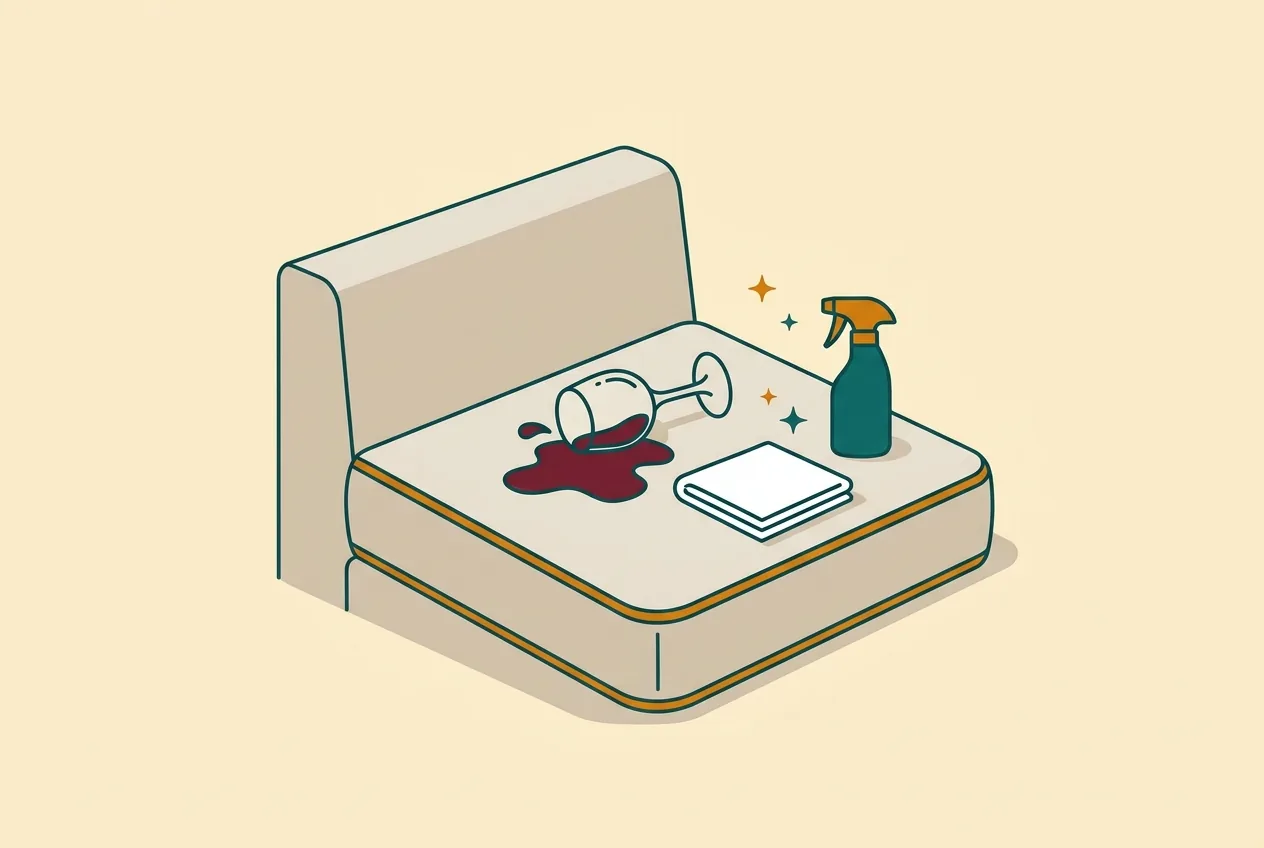
W or WS upholstery, dry-cleaning solvent only on S fabrics, and a professional on X tags. Skip baking soda + vinegar fizzing pastes, which turn red wine blue-grey and leave salt crust in the cushion.S-coded fabric. Viscose, rayon, raw silk, linen blends and many velvets develop permanent brown water rings or crushed pile the moment water touches them.Every manufacturer sews a cleaning code under seat cushions or along the underside decking. Knowing which one you have saves more sofas than any bottle of stain spray (for immediate first-60-seconds checks on carpets or clothes too, see our interactive Stain Solver).
Look for W, WS, S, or X — and check whether the cover unzips cleanly.
W or WS (water-safe synthetic microfibre, polyester, treated cotton)Cold water, mild clear dish soap, and diluted white vinegar applied on a wrung cloth are safe after a 10-minute hidden-seam test.
S or X (viscose, velvet, raw silk, dry-clean-only linen)Stop all water, club soda and vinegar immediately. Blot dry only, use a water-free S-code upholstery solvent with windows open, or call an upholstery cleaner for X.
W/WS tags; distilled water reduces hard-water ring risk on pale cotton)W-coded synthetic cushions with a remaining pink shadow: oxygen bleach (sodium percarbonate)S-coded sofas only: commercial water-free dry-cleaning upholstery solventW and WS sofas (microfibre, polyester, durable cotton)Mix 1 tablespoon of distilled white vinegar and 1 tablespoon of clear mild dish soap into 2 cups (500 ml) of cold water. Do not add baking soda or salt to the mixture.
Why this works: Mild acetic acid keeps red wine's anthocyanin dyes in their soluble pink form rather than shifting them blue-grey, while clear dish soap lifts wine tannins and grape sugars without leaving brighteners behind — the exact low-acid principle behind our dried red wine on wool carpet guide. (If a milky latte or black brew stained your couch instead, see our coffee stain on a sofa guide for dairy-protein steps.)
S-coded sofas (velvet, viscose, rayon, dry-clean-only linen)W-coded synthetic upholsteryWait until the spot is completely dry before judging the shadow. If a light pink mark remains on a pale synthetic W sofa, dissolve ½ teaspoon of oxygen bleach (sodium percarbonate) in 1 cup of cool-to-lukewarm water, spot-test for 10 minutes, dab onto the shadow with a damp cloth, wait 20–30 minutes without letting it soak deep into the foam, then blot clean with plain cold water. Reserve 3% hydrogen peroxide strictly for plain white cotton or tested white synthetics — never wool, linen or dark dyes.
Many people remove the wine completely, only to wake up to a faint brown ring around where the wet cloth stopped.
| Method | Safe on W / WS? | Safe on S fabric? | Key risk if misused |
|---|---|---|---|
| Dry blot + cold vinegar & clear dish soap on wrung cloth | Yes | No — water tide rings | Over-wetting drives wine into foam |
| Water-free dry-cleaning upholstery solvent | WS only (spot-test) | Yes | Fumes require open windows |
| Sodium percarbonate (oxygen bleach) cool spot dab | Pale synthetics only | No | Can fade dark or natural dyes |
| Baking soda paste + vinegar fizz | Poor — shifts stain blue-grey | No | Neutralises into salty crust inside weave |
| 3% hydrogen peroxide + dish soap | Light/white fabrics only | No | Permanent bleached pale patches on coloured sofas |
What about white wine or club soda? Cold plain water works just as well on a fresh spill without leaving sugar behind like white wine does — and never pour club soda onto an S-coded cushion because club soda is still mostly water.
Press white towels straight down until dry. Check your cushion code before touching water, soda or sprays.
Use a wrung cold vinegar + dish soap cloth on W/WS, or dry solvent on S, working inward in gentle rounds.
Extract foam moisture under weighted dry towels for 30 minutes and run a fan so zero tide rings set.
X (vacuum and light brushing only — liquids of any kind void fabric finishes or shrink weave).S-coded velvet, viscose, silk or unsealed linen and already left a stiff water ring.No. Baking soda turns acidic red wine pigments blue-purple, and spraying vinegar on top immediately neutralises both into salty water and fizz. Stick to cold diluted vinegar and clear dish soap on a wrung cloth for water-safe sofas.
No. Club soda is still water and causes shrinkage, stiff texture or permanent brown water rings on S-coded upholstery. Blot dry and switch to a water-free dry-cleaning solvent or a professional cleaner.
Tide rings happen when too much water wets the cushion and carries dissolved dirt or fabric sizing out to the drying edge. Weighting dry towels down first, feathering the damp edge with distilled water, and drying with a fan prevents rings.
Usually no — 3% hydrogen peroxide can permanently bleach dyed cotton, linen, microfibre or wool. Always test hidden underside fabric for 10 minutes first, or skip peroxide altogether on dark and natural-fibre sofas.
See how weighted white towel extraction stops deep brown rings from rising back as fibres dry.
Material-safe stain and moisture rules for wool carpet, synthetic pile, hardwood and laminate.

Written by Miah Elias, home cleaning researcher and writer. Methods are checked against manufacturer upholstery codes and basic dye chemistry. This guide contains no affiliate links — ingredients are named generically so you can start with what is already at home.