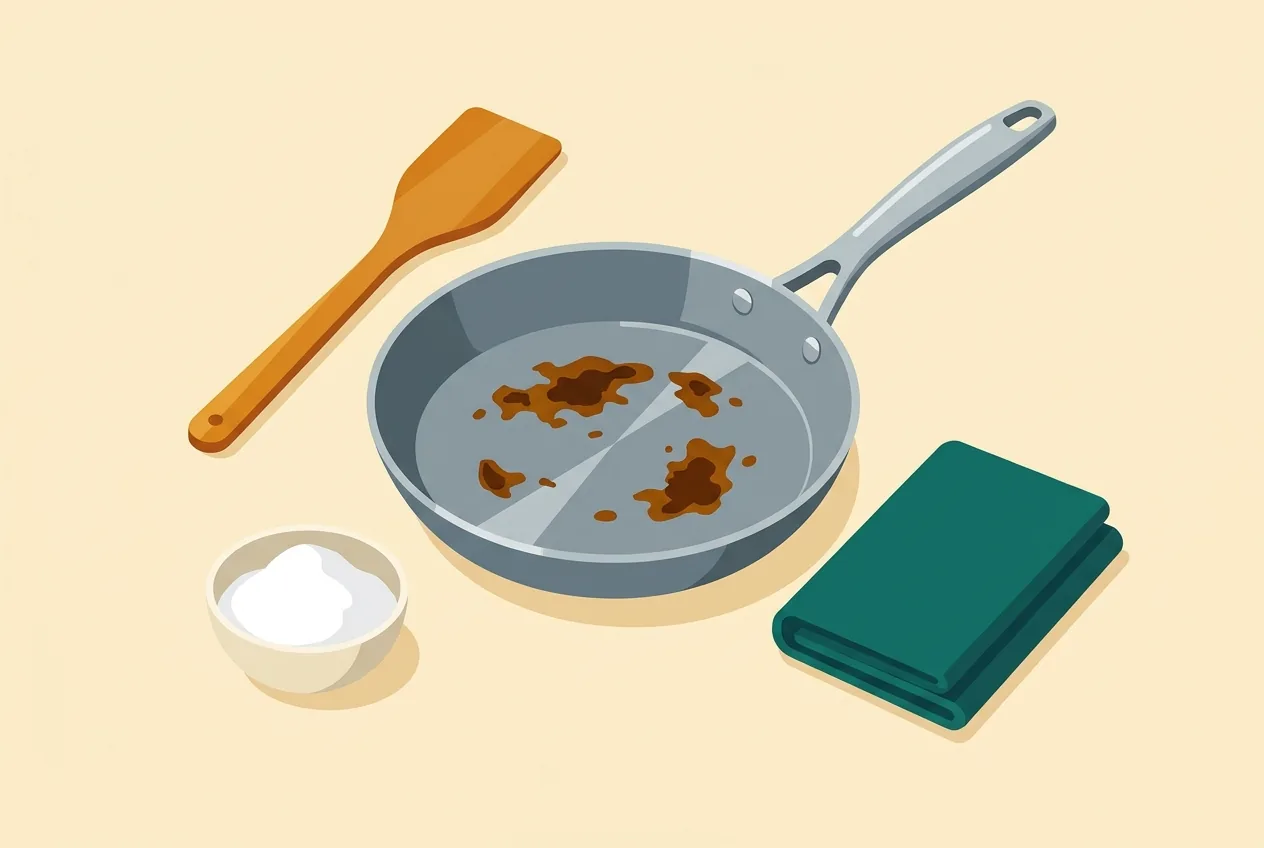
Burnt Stainless Steel Pan? How to Lift Scorched Carbon Without Scratching
By Miah Elias · Published 29 November 2026 · About 7 minutes
Letting the metal cool first and using heat plus alkalinity lifts carbonised food in sheets — without gouging the cooking surface.
Quick answerLet a scorched stainless steel pan cool completely to room temperature first so thermal shock does not warp the base. Cover the burnt area with 2 cm of water and 2 tablespoons of baking soda (never add vinegar into the pot), simmer gently for 10–15 minutes, and push softened black flakes loose with a flat wooden spatula. For leftover amber grease or grey shadows, polish wet along the metal grain with a baking soda slurry or a 60-second oxalic acid cookware paste.
Read this first — four mistakes that permanently ruin stainless cookware
Never plunge a scorching-hot pan into cold tap water. Sudden temperature shock makes tri-ply and bonded-disc bottoms bow or warp so the pan wobbles forever on induction and glass hobs.
Never boil baking soda and vinegar together in the pan. Popular social hacks tell you to mix both for dramatic foam, yet acidic vinegar immediately neutralises alkaline baking soda into weak salty water.
Never use chlorine bleach inside stainless steel. Chloride ions trigger microscopic pitting corrosion on stainless cookware just as they pit tubs in our stainless dishwasher care guide.
Never dry-scour with steel wool, coarse green pads or metal paint scrapers. Deep gouges break the smooth surface tension and cause eggs and meat to stick worse every time you cook afterwards.
Why scorched pans need different fixes for three different marks
Most home cooks grab a rough scouring pad the second a pan turns dark, treating every mark identically. In reality, stainless steel develops three completely separate discolourations that respond to opposite chemistry:
Blue, purple or rainbow swirls (heat tint): A microscopically thin chromium oxide film caused by preheating an empty pan too hot. Scrubbing wastes energy; mild acid clears it in 15 seconds.
Sticky orange-amber edge rings (polymerised oil): Cooking oil vaporised and baked into a resin film around the rim — a steel-pan cousin of sticky polymerised grease on kitchen cabinets.
Thick raised black crusts (charred carbon): Scorched sugars, sauces and proteins bonded tight to the pores. Heat + mild alkali swells and peels those layers from underneath.
First: inspect the cooled pan in good light
Step A: Wait until the handle and base feel cool to touch
Run a finger gently over the discoloured patch — is it smooth or raised?
↓
Smooth rainbow sheen or faint chalky white water spots
Skip heavy scrubbing. Wipe with cold white vinegar or dissolved citric acid for 20 seconds, then wash with dish soap.
↓
Raised black crust, burnt sugar or sticky brown oil varnish
Start with the hot baking soda simmer and flat wooden scraper below, saving oxalic acid only for final thin stains.
What you'll need
Tap water and clear mild dish soap (free)
Baking soda (sodium bicarbonate) and a flat-edged wooden spoon or spatula (free)
A non-scratch blue nylon sponge or soft microfibre cloth
Distilled white vinegar (strictly separate — never mixed with baking soda)
Optional for stubborn dark haze: oxalic-acid cookware cleanser (such as Bar Keepers Friend powder) and rubber gloves
Step 1 — The 15-minute baking soda simmer & wood scrape (free)
Wash away any loose crumbs first with warm soapy water.
Pour enough plain water into the cooled pan to cover all burnt patches by roughly 2 cm, and stir in 2 to 3 tablespoons of baking soda until dissolved. (Do not add vinegar here.)
Set the pan on the hob over medium heat, bring it to a gentle simmer, and hold it simmering for 10 to 15 minutes.
Turn off the heat and, while the water is still warm, nudge across the bottom with a flat-edged wooden spatula. Swelled carbon sheets lift right off with zero metal-on-metal scraping.
Let the liquid cool enough to handle, tip it out, and wash with warm dish soap and a soft nylon sponge.
Why this works: Heat expands the stainless steel slightly faster than the brittle carbon layer, while hot alkaline sodium bicarbonate (around pH 9) softens burnt fats and protein bonds without etching steel — the exact same moisture-and-alkali logic behind softening baked-on oven door grease safely.
Step 2 — Lift remaining brown oil rings or heat tint safely
For remaining brown spots: Sprinkle dry baking soda onto the damp pan with two drops of clear dish soap to form a wet paste. Work in smooth circular strokes following the brushed concentric grain of the pan, keeping plenty of water present so grit never cuts dry steel, then rinse well.
For blue rainbow heat tint or white mineral scale: Once all baking soda is rinsed away, dampen a cloth with plain white vinegar, wipe across the rainbow film for 15–30 seconds until it disappears, then wash straight away with dish soap and buff dry.
For stubborn baked-on exterior base grime (optional): Wet the pan, dust on a thin paste of oxalic-acid cookware cleanser, scrub gently along the grain with a wet blue nylon pad, and rinse thoroughly within 60 seconds. Like all acid pastes, oxalic acid must never dwell for long — the same timing discipline used on delicate hardware in our finish-safe metal descaling guide.
Skip the crumpled aluminium foil ball hack if your pan has a mirror-polished exterior: aluminium smears grey streaks into textured steel and can leave uneven dull patches compared with a wet nylon pad and gentle chemistry.
Burnt stainless steel fixes compared
Methods for cleaning burnt stainless steel pans compared
Method
Lifts charred black food?
Safe for brushed & mirror steel?
Main catch
15-min baking soda simmer + wood spatula
Yes — lifts thick crusts
Yes
Needs an extra paste pass on old oil rims
Wet baking soda + dish soap slurry (with grain)
Good on thin residue
Yes (when kept wet)
Do not scrub dry or cross-grain
Oxalic acid cleanser (under 60 seconds)
Excellent on dark haze & oil
Yes if rinsed under 1 min
Can dull mirror steel if left sitting wet
Plain white vinegar wipe (separate)
No on black carbon
Clears rainbow heat tint fast
Neutralised if mixed with baking soda
Steel wool / chlorine bleach / cold shock
Scours mechanically
No — gouges, pits & warps
Causes permanent sticking and wobble
What about simmering a dishwasher tablet? A plain enzyme tablet can soften thick baked stews on uncoated interior stainless steel, though avoid it on exposed aluminium rims or rivets because strong caustic builders turn raw aluminium dark grey.
Do
Preheat stainless pans dry for 2–3 minutes until water drops dance like mercury balls, then add oil before food so proteins release naturally.
Deglaze warm pan fond straight after cooking with stock, wine or warm water once the pan has cooled slightly.
Dry straight after washing so hard tap-water calcium cannot leave chalky spots.
Don't
Run hot pans straight under the cold tap — let them sit 10 minutes on a trivet first.
Leave acidic tomato sauces or oxalic acid pastes sitting in bare stainless steel overnight.
Use steel wool or aggressive green scouring pads across mirror-polished exteriors or copper-core rims.
When a pan mark is permanent (and harmless)
Fine silver scratches from past metal utensils: Polishing compounds reduce light haze, yet deep knife or steel-wool gouges stay permanently — they are cosmetic only and remain totally food-safe.
Warped spinning bottom from thermal shock: Once clad layers delaminate or bow on a glass hob, no cleaner can flatten the base again.
Darkened exposed aluminium rim edges: Dishwasher detergent oxidises exposed tri-ply edge seams dark grey; it will not harm cooking performance, though hand-washing preserves the rim colour.
FAQ
Should I boil baking soda and white vinegar together in a burnt pan?
No. Baking soda softens carbon because it is alkaline; adding acidic vinegar cancels out that alkalinity into salty water and gas bubbles. Simmer baking soda and water alone, rinse clean, and use vinegar separately only for rainbow heat tint or mineral haze.
How do you remove rainbow or blue stains from stainless steel pans?
Rainbow sheen is harmless chromium oxide formed by high dry heat. Wipe the cooled pan with plain white vinegar or dissolved citric acid for 20 seconds, then rinse and wash with dish soap.
Can I use chlorine bleach or steel wool on a burnt stainless steel frying pan?
Avoid both. Chlorine bleach pits stainless steel permanently, while steel wool scratches the brushed finish and makes future meals stick much worse.
How long can Bar Keepers Friend stay on stainless steel?
Rinse it completely within 60 seconds. Oxalic acid cleans stubborn baked spots fast, yet leaving wet paste sitting for several minutes can dull polished finishes.
Did pan grease or sauce splash onto your apron, rug or hardwood floor? Get instant first-60-seconds rescue steps.
Written by Miah Elias, home cleaning researcher and writer. Methods are checked against cookware manufacturer care manuals and basic metal chemistry. This guide contains no affiliate links — ingredients are named generically so you can start with baking soda and soap.