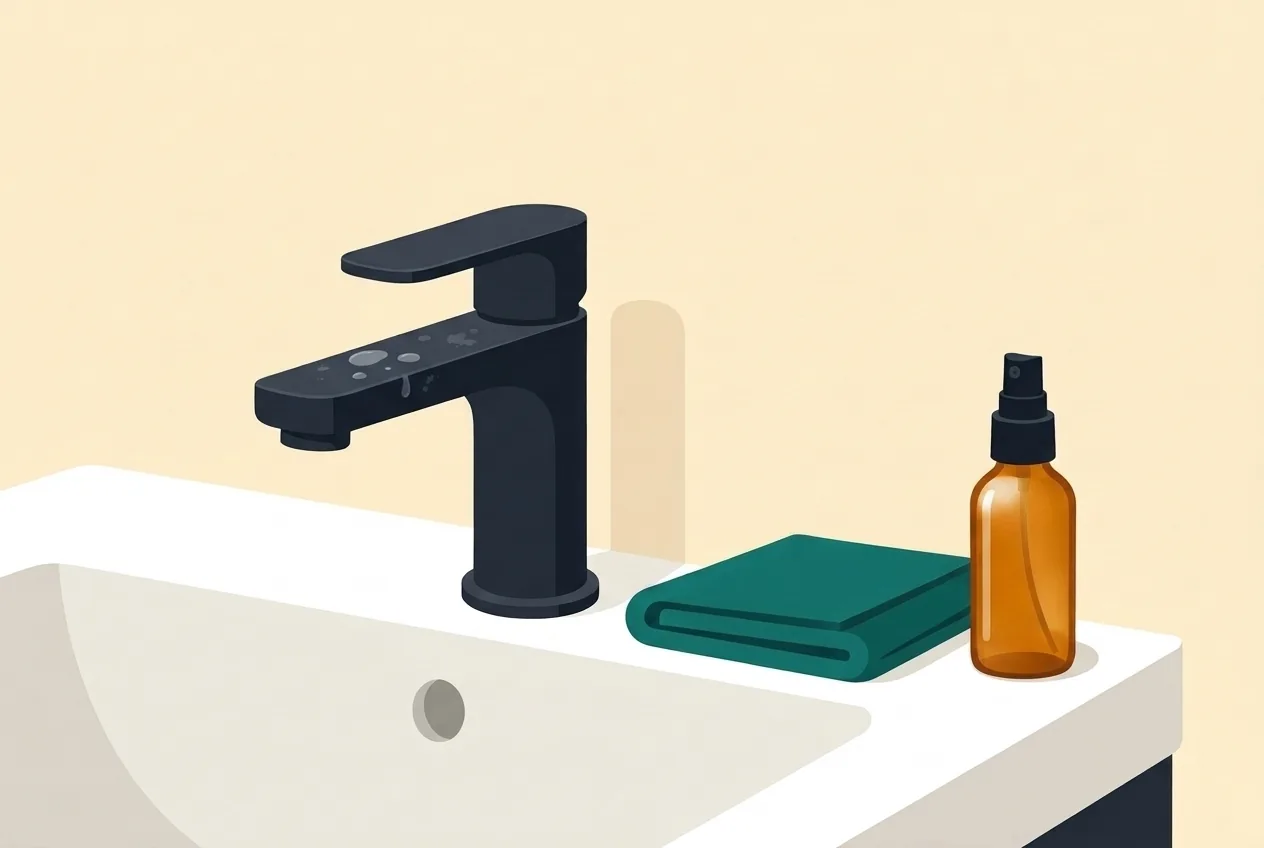
Hard Water Spots on Matte Black Taps? How to Clean Without Peeling the Finish
By Miah Elias · Updated 20 November 2026 · About 6 minutes
Matte black coatings tolerate warm dish soap well — but harsh descalers and Magic Erasers strip them down to bare brass.
Quick answerAlways start with warm water, a few drops of clear dish soap and a soft microfibre cloth — that removes half the cloudy marks caused by hand soap and toothpaste residue. For crusty white calcium rings that stay behind, dab on a 50/50 mix of white vinegar and warm water for 1 to 2 minutes maximum (never wrap a vinegar towel for 30 minutes), rinse immediately with plain water and buff completely dry.
Read this first — five cleaners that ruin matte black finishes
No Magic Erasers, Bar Keepers Friend or scouring pads. Melamine foam acts like ultra-fine sandpaper that buffs away the matte texture, leaving permanent shiny streaks or exposing brass underneath — the exact same abrasion risk behind damaged finishes on lacquered wooden kitchen cabinets.
No CLR, Viakal, bleach, ammonia or acetone. Most tap makers (such as Hansgrohe, Kohler and Moen) specifically warn that hydrochloric/phosphoric descalers, bleach and alcohol-based sprays void warranties on matte black finishes.
Protect natural stone vanity tops underneath. Even mild diluted vinegar etches marble, travertine or limestone basins instantly; lay a damp towel around the tap base if your basin top is stone (see stone surface rules).
Why matte black taps spot so easily — and why popular advice ruins them
Two things catch matte black tap owners off guard. First, white calcium carbonate and magnesium minerals stand out far more dramatically against flat black than against chrome, so every dried droplet looks twice as obvious. Second, not all matte black taps are built the same:
Powder-coated or painted matte black (common on mid-range and budget taps) is a thin polymer or baked-paint layer over brass or stainless steel. Extended acid soaking softens it and causes blistering or peeling.
PVD (Physical Vapour Deposition) matte black bonds metal-nitride molecules harder than paint, yet still relies on a micro-textured top finish that abrasive sponges polish shiny.
Because you rarely know which coating sits under your basin without the box, treating every matte black tap under the stricter powder-coat rules is the only safe path — much like diagnosing mineral scale vs surface damage on shower glass before reaching for stronger chemicals.
First check: is it white limescale on top, or missing coating underneath?
Before wiping anything with vinegar, look closely in bright light:
Chalky pale-white or grey rings (raised slightly): Removable hard-water scale and dried toothpaste/soap scum sitting on top of intact black paint. Proceed to Step 1.
Dull silvery-grey or yellowish brass patches where edges look uneven: The matte black layer has already chipped, rubbed off or peeled chemically. No cleaner can turn bare metal black again; scrubbing further only widens the bare patch.
What you'll need
Warm tap water and clear liquid dish soap (free first step)
Two soft, clean microfibre cloths (one damp, one bone-dry)
White distilled vinegar (only if soap fails on stubborn crusty rings)
A soft-bristled toothbrush for the aerator rim and tap base collar
Step 1 — Wash away soap residue and oils first
Many "hard water spots" on bathroom taps are actually dried hand soap, moisturiser and toothpaste mixed with minerals. Washing those off first often clears the spout completely without touching any acid.
Mix 2–3 drops of clear dish soap into a cup of warm water.
Dip a soft microfibre cloth in the soapy water, wring it well, and wipe the entire tap body, handle and base.
Hold the warm soapy cloth gently over any crusty spot around the spout collar for 60 seconds to soften soap scum, then wipe gently with the soft toothbrush around crevices.
Rinse with a clean water-dampened cloth and buff bone-dry. If the tap looks clean, stop right here.
Step 2 — Use the strict 2-minute 50/50 vinegar limit (only where needed)
Many online tutorials tell you to wrap a matte black tap in vinegar-soaked paper towels for 20 to 30 minutes. Skip that — prolonged acetic acid contact is one of the fastest ways to cloud or lift matte paint.
Mix equal parts white vinegar and warm water (50/50) in a small bowl.
Dampen the corner of a clean microfibre cloth (or a cotton bud for tight rings right around the base flange) in the solution.
Press the damp cloth onto the white mineral ring for 1 to 2 minutes maximum — watch the clock rather than walking away.
Wipe gently in light strokes; use a soft toothbrush dipped in plain soapy water to nudge softened scale out of the base seam without heavy pressure.
If a thick crust around the aerator still lingers, unscrew the aerator insert itself and soak only the removable inner plastic/mesh screen in 50/50 vinegar for 10 minutes — keeping the black outer housing dry.
Why this works: Mildly acidic 2.5% acetic acid reacts quickly enough with thin calcium carbonate deposits within 1–2 minutes to loosen their grip, while short contact plus immediate rinsing prevents acid from swelling painted or electroplated coatings.
Step 3 — Neutral-water rinse and bone-dry buff
Immediately wipe the entire tap with a second cloth soaked in plain warm water so zero vinegar stays sitting on the finish.
Buff completely dry with a fresh, dry microfibre cloth — paying close attention to the base ring where water pools.
For kitchen mixer taps exposed to both hard water and cooking vapours, follow the same mild-soap rule outlined across our kitchen fixture and surface guides rather than spraying general kitchen degreasers.
Matte black tap cleaners compared
What's safe vs risky on matte black fixtures
Method / Product
Removes limescale?
Safe for matte black coating?
Notes
Warm water + clear dish soap + dry microfibre
Clears light water marks & soap scum
Yes — safest daily fix
Zero acid; ideal for weekly wipes
50/50 warm water + white vinegar (1–2 min max)
Loosens moderate mineral rings
Yes, with strict time limit
Rinse immediately with plain water and buff dry
30-minute vinegar towel wrap
Dissolves heavy scale
Risky on painted/powder-coat
Prolonged acid dwell can cloud or lift finish
CLR, Viakal or acidic bath sprays
Strong descaler
No
Explicitly voids most matte black tap warranties
Magic Eraser / Bar Keepers Friend
Abrades scale mechanically
No — sands finish off
Leaves glossy streaks or exposes bare brass
Always check your tap manufacturer's care sheet first — most brands recommend only warm soapy water and a soft cloth, reserving diluted vinegar strictly for brief spot-wipes when water hardness is severe.
Do
Keep a small microfibre cloth beside the basin for a 5-second dry wipe after brushing teeth or washing hands.
Unscrew and soak the hidden aerator screen separately when spray flow slows down.
Check water hardness — a simple shower/basin dry habit prevents rings altogether.
Don't
Wrap soaked vinegar rags or spray foaming bathroom cleaners onto matte black handles.
Use abrasive pads, whitening toothpaste, baking soda scrubs or melamine foam.
Leave wet soap dispensers or damp sponges resting against the black tap base collar.
When the finish has already peeled or turned patchy
If bare brass, copper or silver metal is peeking through, or if a previous cleaner left a cloudy, softened patch that stays uneven when bone-dry, stop trying cleaning fixes. Small edge chips on painted matte taps can sometimes be disguised cosmetically with an enamel touch-up pen matched to matte black, while peeling across the spout within the first year or two is often worth photographing for a manufacturer warranty claim before replacing the fixture.
FAQ
Can I wrap a vinegar-soaked paper towel around a matte black faucet?
No — skip 15 to 30 minute wraps. While solid chrome tolerates longer vinegar soaks, painted and powder-coated matte black taps can blister, fade or dull from prolonged acid contact. Limit 50/50 warm water and vinegar to 1–2 minutes, then rinse and dry straight away.
Why did a Magic Eraser or CLR ruin my matte black tap?
Magic Erasers are micro-abrasive melamine foam that physically sands off the matte top layer, turning flat black glossy or patchy. Strong acid descalers like CLR chemically attack thin decorative coatings.
Should I put mineral oil or wax on a matte black faucet?
Check your brand's care sheet first. Most tap makers advise against mineral oil or furniture polish because oils trap dust, fingerprints and lint; drying with a microfibre cloth keeps the flat matte look clean without residue.
Can peeled matte black tap coating be fixed with cleaning?
No. Once bare brass or silver shows through, the decorative layer is physically gone. Small nicks can be touched up cosmetically, but widespread peeling requires warranty replacement or a new tap.
Control bathroom moisture and clean porous grout safely with 3% hydrogen peroxide.
Written by Miah Elias, home cleaning researcher and writer. Methods are checked against tap manufacturer care sheets and basic surface chemistry. This guide contains no affiliate links yet — products are named by type so you can choose any brand.